
Can Waystar scale without breaking execution?
Waystar must prove its systems can handle more clients, more claims, and more handoffs without slowing service. That matters because payment workflows fail fast when operations lag. The Waystar Ansoff Matrix helps frame that growth test.
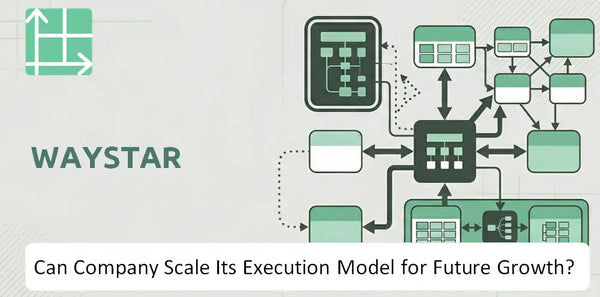
Watch whether onboarding, integrations, and support stay consistent as volume rises. If they do, scale can lift margins; if not, growth gets noisy.
Where Can Waystar Still Grow Through Execution?
Waystar can still grow most credibly by deepening use inside the same provider workflow. The strongest Waystar growth strategy is more automation per customer, more transactions per account, and a larger share of payment steps on its platform.

Deepening workflow use is the clearest execution-led growth path
Waystar company scaling looks strongest when it expands from one revenue-cycle task into adjacent steps in the same client site. That improves Waystar operational efficiency for expansion because each added workflow can lower manual work and raise stickiness.
For a fuller view of the mechanics, see Revenue Execution of Waystar Company
- Expand across more revenue-cycle steps
- Use automation to cut manual rework
- Raise transaction volume per account
- Increase retention through workflow depth
- Lift account value without new logos
This is the cleanest Waystar execution model analysis because it builds on what the platform already does well: cloud delivery, workflow automation, and payment processing tied to provider operations. When a customer runs more of its payment flow through one system, Waystar business expansion can come from usage growth, not just new sales.
That matters for Waystar business model scalability. The more revenue-cycle steps Waystar owns, the more leverage it gets from the same installed base, which supports Waystar future growth, Waystar revenue growth and scalability, and stronger account economics.
- More usage means higher switching costs
- More steps mean more data flow
- More automation can reduce service load
- More throughput can improve margin mix
Waystar strategic execution for growth is most credible when it focuses on adoption inside existing workflows, not broad expansion into unrelated markets. That is where Waystar ability to scale operations is most visible, because the same product, same customer, and same workflow can carry more volume with less friction.
For investors, the key Waystar company growth outlook is simple: if Waystar management strategy for scaling keeps adding value per customer, then Waystar performance and growth potential can rise even before large new logo wins arrive.
Waystar Ansoff Matrix
- Organized to Save Time on Analysis
- Fully Customizable
- Editable in Excel & Word
- Professional Formatting
- Investor-Ready Format

What Must Waystar Improve to Scale?
Waystar must make onboarding, integration, and support far more repeatable to scale cleanly. Its Waystar execution model depends on fewer manual handoffs, faster go-live cycles, and steadier service as volume rises.
 Standardize onboarding and integration first
The most urgent fix in the Waystar growth strategy is to reduce custom setup work across payer rules, data formats, and system handoffs. That means tighter playbooks between sales, implementation, support, and product so each new client follows the same path.
Without that discipline, Waystar company scaling gets slowed by exceptions and rework. The goal is simple: fewer manual steps, shorter go-live time, and less strain on the core platform.
Build service capacity that can hold quality
Waystar operational scalability also depends on enough technical and service talent to absorb growth without letting support slip. As complexity rises, custom requests can crowd out product work unless the team has clear rules for what gets built, fixed, or declined.
That is why the Waystar execution model analysis points to process control and staffing depth as the main blockers to Waystar future growth. For a useful reference point, see the Execution History of Waystar Company.
Waystar SWOT Analysis
- Clean, Modern, and Easy to Present
- No Research Needed – Save Hours of Work
- Built by Experts, Trusted by Consultants
- Instant Download, Ready to Use
- 100% Editable, Fully Customizable

What Could Break Waystar's Execution Story?
Waystar execution story can break if each new client, payer rule, or provider system needs custom handling. That raises implementation time, adds rework, and weakens Waystar operational scalability, so Waystar company scaling starts to look like a services-heavy model instead of software leverage.
| Execution Risk | How It Could Disrupt Scale | Why It Matters |
|---|---|---|
| Provider integration delays | Slower onboarding pushes work into manual fixes and project support. | Each delayed go-live hurts Waystar growth strategy and raises delivery cost. |
| Fragmented claims data | Inconsistent inputs create rework across patient, claims, and payment workflows. | Small data errors can cascade, which weakens Waystar operational efficiency for expansion. |
| Payer rule changes | Frequent payer updates force product tweaks and support load. | Waystar business expansion gets harder when every rule change needs rapid rebuilds. |
The most serious risk is fragmented claims data, because it hits the whole flow at once. If the data layer is inconsistent, the Control and Accountability at Waystar Company issue shows up fast: more manual review, more support tickets, and slower deployment. That is the clearest threat to Waystar execution model analysis, since software scale depends on repeatable workflows, not exception handling. In revenue-cycle tools, even a small error can trigger follow-up work across eligibility, claims status, and payment posting, so Waystar future growth depends on keeping each rollout standardized, not custom.
Waystar Marketing Mix
- Structured to Support Better Decisions
- Effortlessly Communicate Your Business Strategy
- Investor-Ready Format
- 100% Editable and Customizable
- Clear and Structured Layout

What Does the Outlook Say About Waystar's Operational Readiness?
Waystar looks conditionally ready for growth, not fully de-risked. The Waystar execution model benefits from recurring, workflow-heavy tasks, but the Waystar company scaling story still depends on tight implementation, fast response times, and disciplined handoffs as volume rises.
Strongest readiness signal: workflow automation supports scale
The core Waystar growth strategy fits a repeatable SaaS-style model. When software handles repetitive revenue cycle work, each new client can add more volume without adding staff at the same pace, which helps Waystar operational scalability.
That is also why this company fits a use case for Waystar operating principles for scale. The model should improve as automation and data feedback loops deepen.
Readiness concern that remains: execution strain can surface fast
The main risk in Waystar future growth is operational inconsistency. If implementations stop being standardized or support slows, the Waystar execution model analysis turns less favorable because growth pressure can expose weak coordination quickly.
For Waystar business expansion, the test is simple: keep service levels stable while more clients come on. If that slips, Waystar ability to scale operations weakens before revenue growth and scalability can fully show up.
Waystar PESTLE Analysis
- Designed for Fast Business Analysis
- Structured for Consultants, Students, and Founders
- 100% Editable in Microsoft Word & Excel
- Instant Digital Download – Use Immediately
- Compatible with Mac & PC – Fully Unlocked

Related Blogs
- What Do the Mission, Vision, and Values of Waystar Company Reveal About How It Operates?
- How Did Waystar Company Build Its Execution Model Over Time?
- Who Owns Waystar Company and How Does Ownership Affect Accountability?
- How Does Waystar Company Actually Run Day to Day?
- How Does Waystar Company Execute Across Sales, Service, and Retention?
- Which Customers Fit Waystar Company's Operating Model Best?
- How Does Waystar Company Compete Through Execution?
Frequently Asked Questions
Waystar's execution-led growth comes from widening adoption across the revenue cycle, not from inventing a new market. Waystar already covers 3 core stages - patient engagement, claims processing, and payment - so each added workflow can lift revenue per customer. The main indicators are onboarding speed, attach rate, and lower manual work per transaction.
Disclaimer
All information, articles, and product details provided on this website are for general informational and educational purposes only. We do not claim any ownership over, nor do we intend to infringe upon, any trademarks, copyrights, logos, brand names, or other intellectual property mentioned or depicted on this site. Such intellectual property remains the property of its respective owners, and any references here are made solely for identification or informational purposes, without implying any affiliation, endorsement, or partnership.
We make no representations or warranties, express or implied, regarding the accuracy, completeness, or suitability of any content or products presented. Nothing on this website should be construed as legal, tax, investment, financial, medical, or other professional advice. In addition, no part of this site - including articles or product references - constitutes a solicitation, recommendation, endorsement, advertisement, or offer to buy or sell any securities, franchises, or other financial instruments, particularly in jurisdictions where such activity would be unlawful.
All content is of a general nature and may not address the specific circumstances of any individual or entity. It is not a substitute for professional advice or services. Any actions you take based on the information provided here are strictly at your own risk. You accept full responsibility for any decisions or outcomes arising from your use of this website and agree to release us from any liability in connection with your use of, or reliance upon, the content or products found herein.